16A vs. 32A Home EV Chargers: How to Choose

Many new electric vehicle (EV) owners face a common decision: should they choose a 16A EV charger or a 32A EV charger? This choice directly affects charging speed and the overall user experience. If the selection is not appropriate, it may lead to excessively long charging times or unnecessary costs, both of which can reduce everyday convenience. Therefore, making the correct decision based on vehicle type and charging needs is essential.
From a charging speed perspective, a 16A charger is significantly slower than a 32A charger. Under normal conditions, a full charging cycle with a 16A charger takes around 7 hours, while a 32A charger typically takes about 3.5 hours. However, the final decision still depends on the vehicle's onboard charger capability and daily usage habits. If charging mainly takes place overnight, a 16A Level 2 EV charger is often sufficient. But if faster charging or frequent vehicle use is required, a 32A AC charger is a more suitable option.
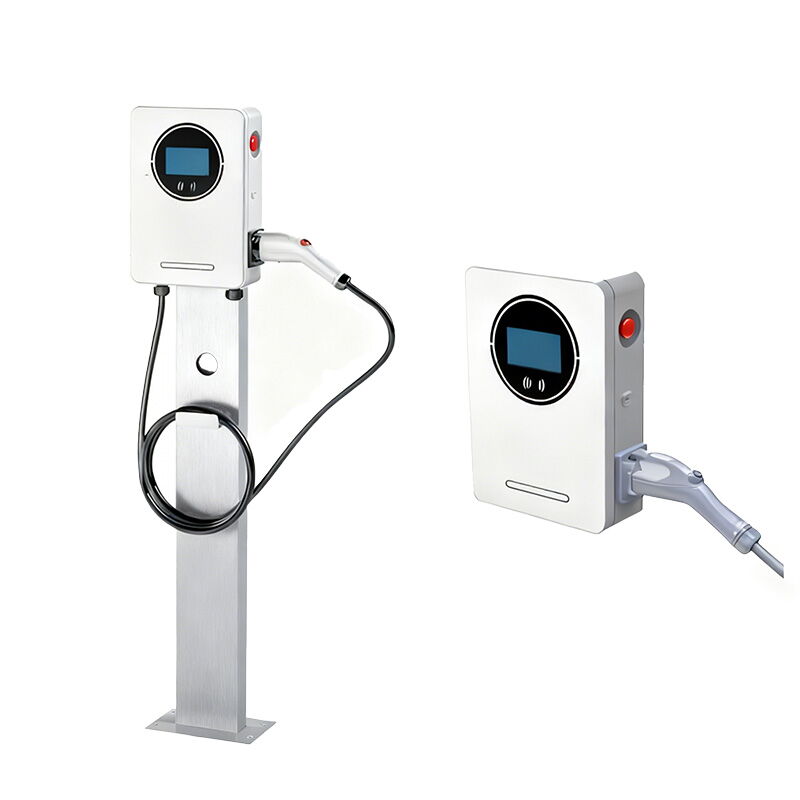
A home electric vehicle charger is a device that transfers electrical energy from a household power supply to an EV battery. It is installed in a residential setting, allowing vehicle owners to charge their cars during the night or while parked.
Compared to public charging stations, home chargers offer greater convenience, lower cost, and the ability to take advantage of off-peak electricity rates.
Home chargers are typically Level 2 chargers, operating on 220V to 240V AC power. This charging method is much faster than standard household outlets (Level 1) and more suitable for daily home use compared to DC fast charging systems. The key parameter of a Level 2 charger is current (amperage), with the most common specifications being 16A and 32A.

In home EV charging, "ampere (A)" refers to the amount of electrical current, which determines how quickly electricity flows from the home grid to the vehicle battery. The higher the current, the more electricity is delivered per unit of time, and the faster the charging speed.
Most household electrical systems use a single-phase power supply. In this system, a 16A charger provides approximately 3.6 to 3.7 kW of power, while a 32A charger delivers about 7.2 to 7.4 kW. Numerically, 32A output is nearly double that of 16A, meaning that under ideal conditions, charging speed is also about twice as fast.
This relationship can be compared to water flow: a 16A charger is like a narrow pipe with steady but limited flow, while a 32A charger is like a wider pipe that allows a larger flow rate. The EV battery is like a container—the larger the flow, the faster it fills. Therefore, higher amperage means faster charging, provided that both the vehicle and household electrical system can support it.
There are several reasons why 16A and 32A have become the mainstream home charging specifications.
First, both are technologically mature and stable, with controllable manufacturing costs, making them suitable for mass production and widespread household adoption. Second, they meet different user needs: 16A is suitable for basic charging requirements, while 32A is designed for faster and more efficient charging. Third, most residential electrical systems can support these two specifications without requiring major electrical upgrades.
After understanding the basic concepts, it is important to compare the two chargers across multiple dimensions, including power output, charging time, vehicle compatibility, installation requirements, and cost.
A 16A charger has a maximum output current of 16 amps. Under a single-phase 220V system, its output power is approximately 3.6 kW. This level of power is suitable for most daily charging scenarios, especially overnight charging.
A 32A charger has a maximum output current of 32 amps. Under the same voltage, its output power is about 7.2 kW. Since the current is doubled, the power output is also doubled, allowing significantly faster energy transfer.
This power difference directly affects charging efficiency. In terms of range gained per hour, a 16A charger typically adds about 12 to 15 miles (19 to 24 km) of range per hour, while a 32A charger can add approximately 25 to 30 miles (40 to 48 km) per hour. For users with short daily commutes, this difference may not be very noticeable. However, for users who require fast top-ups, the advantage of a 32A charger is very clear.
Charging time is one of the most important concerns for users. It depends on battery capacity, charging power, and current battery state of charge.
For example, consider an EV with a 60 kWh battery:
With a 16A charger, a full charge from empty typically takes around 16 hours. In real-world usage, however, since batteries are rarely fully depleted and energy losses occur during charging, the actual time is usually 8 to 12 hours. This means that if charging starts at 10 PM, the vehicle can be fully charged by 6–8 AM the next morning.
With a 32A charger, the same battery can be fully charged in about 8 hours from empty. In practical use, charging time is usually reduced to 4 to 6 hours. This means that even if charging starts later in the evening, it can still be completed before early morning, ensuring sufficient range for the next day.
For smaller battery EVs, such as the Nissan Leaf (around 40 kWh), a 16A charger is usually sufficient for overnight charging. For larger battery vehicles, such as the Tesla Model 3 Long Range (around 75 kWh), a 32A charger significantly reduces waiting time.
Not all electric vehicles support high-power 32A charging. Compatibility depends on the onboard charger (OBC), which is the internal system that converts AC power into DC power for the battery.
In general, a 16A charger is compatible with most vehicles, including older models or those with smaller battery capacities. Even if a 32A charger is used, charging speed will not increase if the vehicle’s onboard charger limits input current.
A 32A charger is more suitable for newer or higher-capacity EVs. Models such as Tesla Model S, Audi e-tron, and BMW iX typically support higher charging inputs and can fully utilize the benefits of 32A charging.
Before selecting a charger, it is essential to check the vehicle’s official specifications to confirm the maximum supported input current. If the vehicle only supports 16A, purchasing a 32A charger will result in unnecessary expense.
A 16A charger has relatively low electrical system requirements. Most household circuits can support it without major modifications. It can usually be installed using existing wiring, making installation simple and cost-effective.
A 32A charger requires a more robust electrical setup. It typically needs a dedicated circuit and at least a 40A circuit breaker. This means dedicated wiring from the distribution panel to the charger location.
The total household electrical capacity must also be considered. Most homes are limited by a main fuse rated at 60A, 80A, or 100A. In a 60A system, using a 32A charger while running other high-power appliances such as water heaters, ovens, or air conditioners may cause overload. In such cases, a dynamic load balancing system may be required.
A dynamic load balancing system is an intelligent power management device that automatically reduces charging power when household load is high and restores full charging when demand decreases. This prevents tripping and ensures electrical safety.
A 16A charger is more economical in both equipment and installation costs. Due to lower power requirements, it uses simpler internal components and requires less complex cooling systems. Installation is also cheaper because no dedicated circuit or large breaker is needed.
A 32A charger has a higher initial cost. The device itself is more expensive, and installation requires dedicated wiring, a larger breaker, and possibly electrical system upgrades. If a load management system is needed, this adds further cost.
However, in the long term, a 32A charger offers better efficiency and convenience. Faster charging allows more flexible vehicle usage and better utilization of off-peak electricity rates, which are usually lower at night.

After understanding the detailed comparison between the two types of chargers, the next step is to determine which charger is more suitable for your specific situation based on different usage scenarios.
Users with short daily driving distances are the primary candidates for 16A chargers. If daily mileage is within 30 to 50 km, a 16A charger is usually sufficient.
Plug-in hybrid vehicle (PHEV) owners are also well suited for 16A chargers, as their batteries are smaller and can be fully charged within a few hours.
Homes with older electrical systems that are difficult to upgrade should also consider 16A chargers due to safety and cost concerns.
Budget-conscious users benefit from lower equipment and installation costs.
Additionally, 16A charging generates less heat, which can help reduce battery stress and potentially extend battery life.
Full battery EV users with larger battery capacities (above 60 kWh) benefit more from 32A chargers due to significantly shorter charging times.
Users who require fast daily charging or have irregular schedules also benefit from faster top-ups.
Frequent long-distance commuters and households with multiple EVs will find 32A chargers more efficient.
Users who want to take advantage of off-peak electricity pricing also benefit from faster charging within limited time windows.
For households with multiple EVs, either dual 16A chargers or one 32A charger with a smart control system may be appropriate.
For users needing daytime quick top-ups, a 32A charger provides significant flexibility.
Apartment or townhouse residents must confirm electrical capacity and building regulations before installation.
- Evaluate Household Electrical Capacity: A professional electrician should assess main fuse rating, distribution board capacity, and existing load conditions before installation.
- Confirm Vehicle Charging Specifications: Always verify the vehicle's maximum charging input via manual or manufacturer specifications.
- Choose Proper Installation Location: The charger should be installed close to the parking area to minimize cable length and energy loss. Outdoor installations require proper IP-rated protection (typically IP55 or higher).
- Understand Local Policies and Incentives: Some regions offer subsidies or tax incentives for home EV charger installation. Local HOA or building regulations must also be checked.
The choice between a 16A and 32A charger should be based on actual usage needs rather than assumptions.
A 16A charger is suitable for users with short daily mileage, stable overnight charging time, older electrical systems, or limited budgets. It provides reliable basic charging with lower cost and simpler installation.
A 32A charger is ideal for users who require fast charging, drive long distances, own large-battery EVs, or plan for future vehicle upgrades. Although the initial investment is higher, it offers greater long-term convenience and flexibility.
For most new EV owners, if the home electrical system supports it, a 32A charger is generally recommended due to its future-proof advantages.
Regardless of the choice, it is important to use certified equipment and professional installation. This ensures not only charging efficiency but also household electrical safety and battery longevity.
Before making a final decision, it is advisable to consult the vehicle manufacturer, charger supplier, and a qualified electrician to ensure the best possible charging solution based on vehicle specifications, home electrical conditions, usage habits, and budget.