
With the rapid growth of electric vehicles (EVs), the development of charging infrastructure is accelerating. For ev charging station operators, one critical decision is which communication protocol to adopt for connecting charging points to energy management systems. Two of the most widely discussed options in the market today are OCPP and Modbus. This article provides a detailed comparison of these two protocols for EV chargers, analyzing their technical characteristics, suitable applications, advantages, and limitations to help operators make informed choices.
Before diving into a detailed comparison, it is essential to understand what each protocol is, where it comes from, and the problems it is designed to solve. This section introduces the basic definitions and core purposes of OCPP and Modbus.
OCPP stands for Open Charge Point Protocol. It is a communication standard specifically developed for EV charging stations. The primary function of OCPP is to facilitate data exchange between charging points and a backend charging station management system (CSMS). Operators can remotely monitor charging point status, start or stop charging sessions, adjust charging power, and upgrade firmware via OCPP. As an open protocol, OCPP allows charging points from different manufacturers to connect to the same backend system, avoiding vendor lock-in issues.
Modbus is a communication protocol widely used in industrial automation, first developed in 1979. Its characteristics include simplicity, reliable data transmission, and low communication overhead. Devices commonly found in charging stations, such as electricity meters, temperature sensors, and card readers, can communicate via Modbus. Modbus does not depend on internet connectivity, allowing direct data exchange between devices over serial interfaces or Ethernet. This feature makes Modbus particularly suitable for local control scenarios, such as integrating charging points with solar systems or fixed battery storage.
After understanding the basic concepts, it is important to identify the fundamental differences between the two protocols, as these directly determine their appropriate use cases. The following comparison is based on communication method, application scenarios, and device interoperability.
OCPP relies on cloud connectivity. Charging points connect to the backend system via mobile networks or broadband. When the network is stable, OCPP functions reliably. However, in areas with weak mobile signals, delays or command failures may occur, affecting station operation.
Modbus, on the other hand, does not depend on the internet. Devices communicate directly with each other, and local operations continue even if the external network is down. This feature is particularly important for critical infrastructure such as highway service areas or logistics hubs, where network outages could cause operational losses. Modbus ensures that basic charging station functions remain operational under such conditions.
Differences in communication methods lead to distinct use cases for each protocol. The type of station an operator manages significantly influences protocol selection.
OCPP is suitable for standardized, simple charging stations. For sites with a limited number of charging points and no need for complex local energy management, OCPP provides sufficient remote monitoring and static load management. Operators can manage multiple stations centrally, consolidating operational data and charging records.
Modbus is ideal for complex stations that integrate multiple energy devices, such as charging points, solar panels, fixed battery storage, and grid controllers. In these scenarios, Modbus enables rapid coordination between devices, ensuring balanced load distribution and preventing grid overload.
Interoperability between devices is another critical consideration when choosing a protocol. OCPP and Modbus differ significantly in this aspect.
OCPP offers high interoperability among charging points. Any OCPP-compliant charging point, regardless of brand, can connect to the same backend system. Operators can freely select hardware based on cost, performance, and other criteria, without being tied to a single vendor.
Modbus is not specifically designed for charging stations. Different manufacturers may implement Modbus registers differently, requiring custom interface programs for compatibility. In some cases, dedicated gateway devices are needed to translate protocols.
With an understanding of OCPP's basic characteristics, operators should evaluate its strengths and limitations to determine whether it is suitable for their project.
High cross-vendor interoperability: Operators can manage multiple brands of charging points from a single backend system, allowing flexible hardware selection.
Support for smart charging functions: OCPP can automatically adjust charging power based on grid load or electricity pricing, enabling peak shaving, valley filling, and cost reduction.
Convenient remote management: Operators can monitor all charging points, upgrade firmware remotely, adjust parameters, and handle faults via the backend system, reducing onsite maintenance workload.
Despite its advantages, OCPP is not suitable for all scenarios. Its limitations are particularly noticeable in sites with poor network conditions or complex device configurations.
Cloud dependency: If the network is interrupted, the backend cannot control charging points, and some smart functions may fail.
Unsuitable for real-time local control: OCPP typically has response times measured in seconds, which may be insufficient for local control tasks requiring millisecond-level responsiveness.
Limited multi-technology integration: While OCPP ensures interoperability between charging points, it does not necessarily allow direct communication with solar inverters, battery management systems, or other non-charging devices, requiring additional integration work.
Similar to OCPP, Modbus has distinct strengths and weaknesses. For operators familiar with OCPP, understanding Modbus helps achieve a balanced technology decision.
Fast local communication: Modbus devices communicate directly, with response times typically under tens of milliseconds, ideal for dynamic load balancing and real-time control.
Good integration with energy devices: Widely used in the energy sector for decades, Modbus is supported by most solar systems, battery storage units, and electricity meters, making integration straightforward.
Network independence: Local operations continue even if the internet is down, enhancing system resilience.
However, Modbus is not without drawbacks, particularly in terms of interoperability and configuration complexity.
Low interoperability among charging points: Different manufacturers may implement Modbus differently, requiring custom development to achieve compatibility.
Complex configuration: Modbus requires setting device addresses, register mappings, baud rates, and other parameters, demanding technical expertise.
Possible need for gateways: Connecting Modbus devices to an OCPP backend usually requires protocol conversion gateways.
With a clear understanding of the advantages and limitations of both protocols, the next question is how to select the appropriate solution for a specific project. This section presents three typical scenarios for guidance.
For stations with a single type of device and no complex local control, OCPP is sufficient. Examples include slow chargers along city streets or small fast-charging stations in shopping mall parking lots. These sites can leverage OCPP for centralized operation and data monitoring without deploying additional local control systems, reducing construction and maintenance costs.
For critical infrastructure with multiple energy devices, Modbus provides more reliable local control. For instance, charging hubs connected to grid controllers, solar systems, and fixed battery storage benefit from Modbus. Even if the network fails, local load management continues, avoiding overloads and associated penalties.
Increasingly, operators adopt hybrid solutions to combine the strengths of OCPP and Modbus. This approach is currently considered ideal.
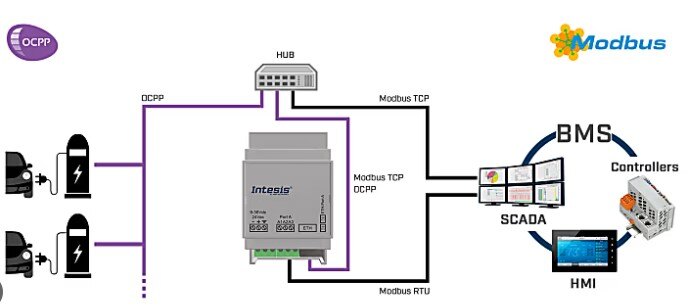
In practice, OCPP manages communication between charging points and the backend system for remote monitoring, billing, and user authentication. Meanwhile, Modbus handles local integration with electricity meters, solar systems, and battery storage. Protocol conversion gateways connect the two systems, allowing OCPP commands to be translated into Modbus instructions for local devices and local data to be sent to the cloud. This setup combines intelligent cloud management with real-time local execution.
Beyond protocol comparison, Modbus itself plays a significant role in charging station operations. Its applications can be categorized into four main areas.
Modbus allows operators to monitor charging point parameters such as voltage, current, power, and energy consumption in real time. Charging rates can be adjusted as needed, ensuring safe and efficient operation.
Charging points include multiple internal components, such as energy meters, temperature sensors, RFID card readers, and display panels. Modbus enables seamless data exchange and command execution among these components, providing a smooth user experience.
Modbus is crucial for connecting charging points to energy or building management systems. Through Modbus, charging points coordinate with other building loads, enabling:
In typical station architectures, Modbus and OCPP complement rather than compete with each other. Modbus handles internal and local energy device communication, while OCPP manages cloud-based communication. Gateways link the protocols, enabling local data to reach the cloud and cloud commands to reach local devices. This structure ensures fast local responses while maintaining centralized management.
In addition to choosing protocols for current projects, operators should follow OCPP's evolution, as it affects future device compatibility and system scalability.
OCPP has evolved through multiple versions. OCPP 1.6 is currently the most widely adopted, supporting basic and smart charging functions. OCPP 2.0.1 adds enhanced device management, security, and advanced smart charging features. In 2024, the International Electrotechnical Commission officially approved OCPP 2.0.1 as IEC 63584, establishing it as a global benchmark for EV charging communication protocols.
Different operators use OCPP in various ways. For example, fleet operators schedule charging tasks remotely and monitor distributed stations to optimize charging cycles. Grid operators leverage OCPP for dynamic pricing and demand response, reducing charging during peak periods. Charging service providers integrate OCPP with billing systems, membership management, and mobile apps for user convenience. Energy managers create dynamic load curves per site or region to maintain grid stability.
OCPP is rarely used in isolation. It often integrates with other protocols:
With MQTT, OCPP enables lightweight, reliable cloud communication suitable for smart cities or fleet operations.
With BACnet, OCPP allows charging points to integrate into building automation systems, exchanging energy data for optimized load balancing and HVAC synchronization.
With Modbus, legacy industrial systems can communicate with EV charging infrastructure through protocol gateways or edge software, translating data for cross-system interoperability.
In summary, OCPP and Modbus each have distinct use cases; no single protocol suits all scenarios. Operators' choices should be based on site-specific conditions and operational requirements.
OCPP excels in cross-vendor interoperability and remote management, making it ideal for standardized, simple stations. Modbus offers reliable local control and seamless integration with energy devices, suitable for complex stations with multiple devices.
For most charging station projects, a hybrid approach is recommended: using OCPP to connect charging points with the cloud for remote monitoring and smart charging, while employing Modbus for local integration and real-time control. Protocol gateways enable coordination between the two, ensuring both system openness and expandability, as well as stable and responsive local operation.
Operators should consider factors such as equipment composition, network conditions, and operational needs. For roadside slow-charging stations with good network coverage and uniform equipment, a pure OCPP solution suffices. For critical sites integrating solar panels, battery storage, and grid controllers, Modbus or a hybrid approach should be prioritized to guarantee reliability and resilience.